Starting with social media advertising for beginners can feel confusing. There are different platforms, campaign objectives, audience settings, budgets, ad formats, and performance metrics to understand. By following these social media advertising tips for beginners, you can learn how to create effective ad campaigns, reach the right audience, manage your advertising budget, and improve your results over time.
The good news is that you don’t need to master everything before creating your first campaign. With the right approach, social media advertising tips for beginners can be simple to understand and apply.
Start with one clear goal, identify the people you want to reach, create a useful message, and use campaign data to improve your decisions. Whether you’re learning digital marketing, running a business, or trying paid advertising for the first time, understanding these basics can give you a strong starting point.
What Is Social Media Advertising?
Social media advertising is a form of paid digital marketing where businesses pay social media platforms to display promotional content to selected audiences.
An advertisement can be an image, video, carousel, story, sponsored post, or another format supported by the platform. As part of social media advertising for beginners, it is important to understand that each ad format serves a different purpose. Depending on your campaign objectives, your goal may be to increase brand awareness, drive website traffic, generate leads, promote a product, or encourage sales. Choosing the right ad format and strategy can help you reach your target audience and achieve better advertising results.
It is also important to understand the difference between paid and organic social media marketing.
When you publish a post on your business profile without paying for additional distribution, you’re using organic social media marketing. When you pay to show content to a selected audience, you’re using paid social media advertising.
For example, a business might publish a post about a new service for its followers. It could then create a paid advertisement to introduce that service to a wider group of relevant users.
This ability to reach people beyond an existing audience is one reason social media advertising has become an important part of digital marketing.
Why Social Media Advertising Matters for Beginners
A beginner might wonder why they should pay for advertising when social media allows businesses to publish content for free.
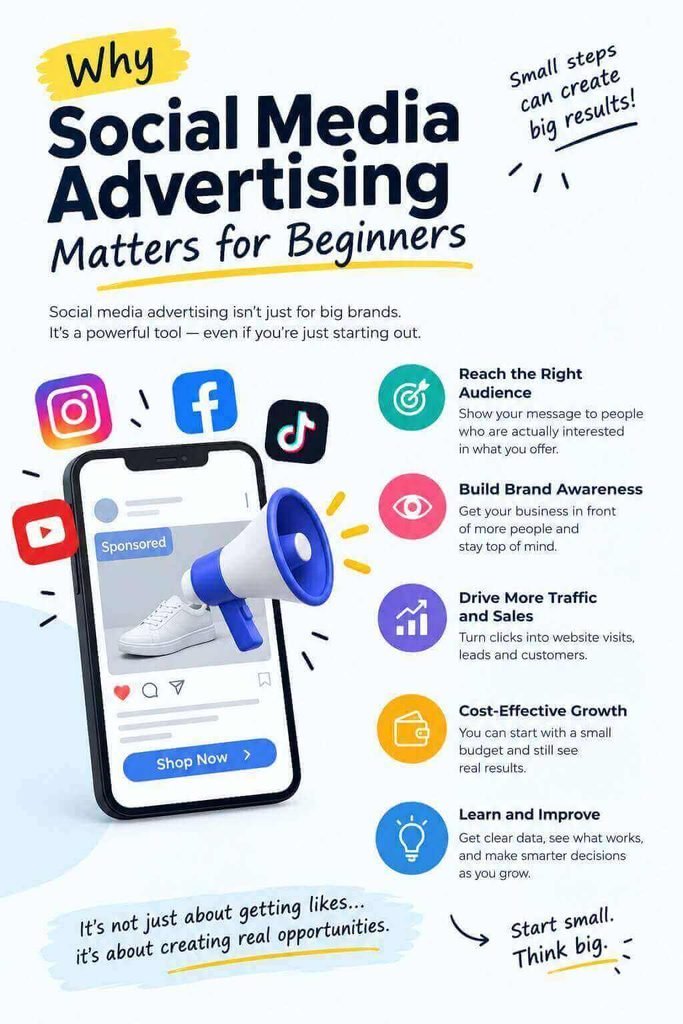
Organic content is valuable for building trust and engaging followers, but growing an audience organically can take time. One of the most effective social media advertising tips for beginners is to combine organic content with paid advertising. Paid social media campaigns help businesses reach a targeted audience, increase brand awareness, drive website traffic, generate leads, and promote products or services more efficiently.
Some potential benefits include:
- Targeted reach: You can use the targeting options available on a platform to reach relevant audiences.
- Brand awareness: Paid campaigns can introduce your business to people who haven’t discovered it yet.
- Website traffic: Advertisements can send interested users to your website or landing page.
- Lead generation: Businesses can use suitable campaigns to collect potential customer information.
- Product promotion: Ads can highlight specific products, services, or offers.
- Measurable performance: Advertising platforms provide data that can help you evaluate campaign activity.
However, advertising should always have a purpose. Getting thousands of views isn’t necessarily useful if those views don’t contribute to your actual business objective
Businesses looking to improve their online presence can benefit from expert guidance. If you want to learn more about social media marketing, SEO, and paid advertising, explore this guide to the best digital marketer freelancer in Thrissur for more information about digital marketing services.
Social Media Advertising Tips for Beginners
1. Define Your Advertising Goal
Before opening an advertising dashboard, decide what you want the campaign to achieve.
Your goal might be to:
- Increase website traffic
- Generate enquiries
- Promote a product
- Build brand awareness
- Collect leads
- Increase registrations
- Generate sales
This decision influences many of the choices you make later.
For example, imagine that your goal is to get people to download an online guide. Your campaign should be built around encouraging relevant users to visit the download page rather than simply trying to maximize the number of impressions.
A clear goal also gives you something meaningful to measure.
Understand Your Target Audience
One of the most important parts of social media ad targeting is knowing who you’re trying to reach.
Instead of asking, “How can I advertise to everyone?”, ask:
Who is most likely to need what I’m offering?
Think about relevant factors such as:
- Location
- Age group
- Interests
- Needs
- Online behavior
- Customer problems
- Buying intent
Choose the Right Social Media Platform
You don’t necessarily need to advertise on every social media platform.
Different platforms have different audiences, content formats, and advertising features. Choose a platform based on where your potential customers are and what you want your campaign to accomplish.
For example, Instagram can be useful for visual campaigns, while LinkedIn can be relevant for professional or business-focused audiences. Facebook offers a wide range of advertising options, while video-focused platforms can be useful for campaigns built around video content.
The right platform depends on your audience and objective rather than simply choosing the most popular network.
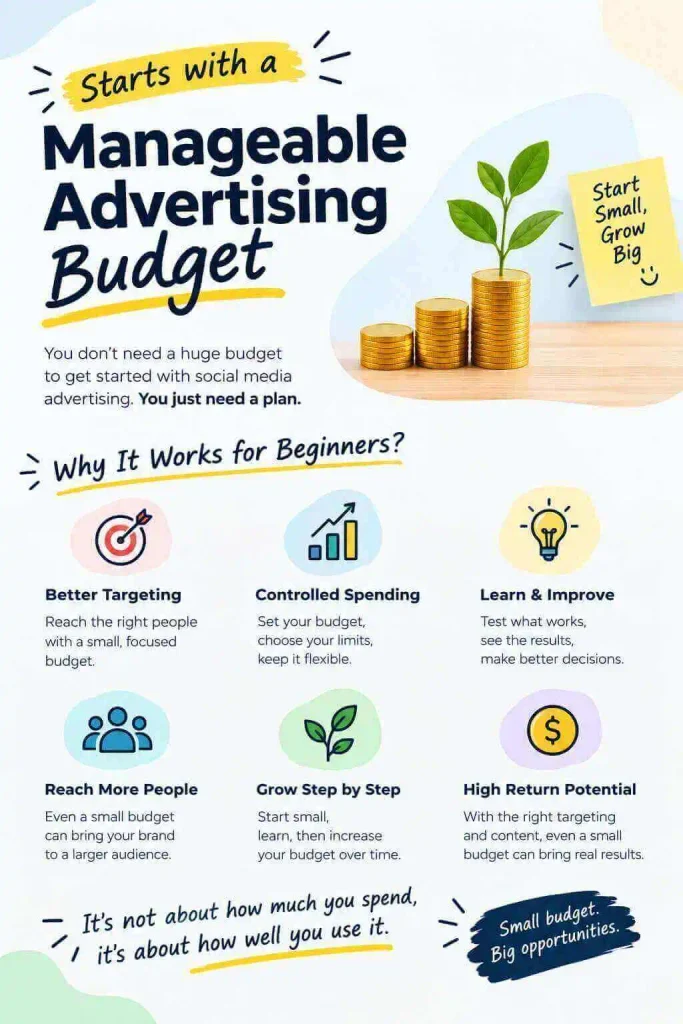
Start With a Manageable Advertising Budget
Your first campaign should be a learning experience when following social media advertising tips for beginners.
That doesn’t mean wasting money. Instead, avoid assuming that you need a large advertising budget to get started.
Begin with a budget that fits your resources and allows you to collect useful campaign data. Monitor important metrics such as reach, clicks, engagement, and conversions to understand how your advertisements are performing.
By analyzing these results, you can identify what works best for your target audience, optimize your ad campaigns, and make smarter decisions about future advertising spending
Create Attention-Grabbing Ad Creatives
Your ad creative is usually one of the first things people notice.
A good image or video should communicate the main idea quickly without making the viewer work too hard to understand it.
When creating your creative:
- Keep the main message clear.
- Use visuals related to your offer.
- Avoid unnecessary design elements.
- Maintain consistent branding.
- Highlight the benefit when appropriate.
You don’t necessarily need an expensive production team. A simple and relevant creative can work well when it communicates the right message to the right audience.
Write Ad Copy That Sounds Natural
Good advertising copy doesn’t have to sound complicated.
Instead of filling your advertisement with marketing jargon, focus on the problem, need, or benefit that matters to your audience.
A simple structure is:
Problem → Solution → Benefit → Call to Action
Finding it difficult to plan your first digital marketing campaign? Learn the basics, understand the key steps, and start building your strategy with confidence.
Landing Page Optimisation: Where Interest Becomes Action
Your advertisement creates the interest. Your landing page creates the opportunity.
In digital marketing, attracting attention is only half the battle. The real challenge begins when someone clicks your advertisement and arrives at your website. What happens next determines whether that visitor explores your offer, becomes a potential lead, or leaves without taking action.
A poorly designed landing page can waste the effort and money invested in advertising. A well-optimised page, however, can transform visitors’ curiosity into meaningful customer action.
What Makes a Landing Page Effective?
- Start with a Strong Message
Capture visitors’ attention with a clear headline that explains what you offer and why it matters to them. - Deliver a Seamless Experience
Create a clean, organised layout that allows visitors to understand your offer without feeling overwhelmed. - Make Speed Your Advantage
A slow website can interrupt a customer’s interest. Optimise images, reduce unnecessary elements, and improve loading speed. - Create a Mobile-First Experience
Since many users discover products through their smartphones, ensure your landing page is easy to navigate on smaller screens. - Turn Visuals into Value
Use relevant photographs, product demonstrations, and videos to help visitors understand what makes your offer worth considering. - Make the Next Step Obvious
Guide visitors towards one primary action, whether it is purchasing a product, submitting an enquiry, or registering for a service. - Earn Trust Through Transparency
Present accurate information, clear pricing, genuine testimonials, and accessible contact details to help customers make confident decisions. - Remove Barriers to Conversion
Avoid complicated forms, confusing navigation, and unnecessary steps that make taking action difficult. - Match the Advertisement to the Page
Ensure that the message, offer, and expectations created by your advertisement are reflected on the landing page. - Improve Through Testing
Experiment with different headlines, images, layouts, and calls to action. Use performance data to identify what works best for your audience.
Example: From a Social Media Click to a Sale
Consider a clothing brand promoting its latest premium collection through Instagram advertisements.
A potential customer clicks the advertisement and lands on a dedicated page featuring the advertised collection, detailed product photographs, available sizes, transparent prices, and a straightforward purchasing option.
There is no need to search through unrelated products or guess what to do next. Every element helps the visitor move closer to making a decision.
This is how a thoughtfully designed landing page supports the customer journey.
The Bigger Picture
Landing page optimisation is not simply about creating an attractive website. It is about understanding customer expectations, removing friction, and making every visit more meaningful.
Remember: An advertisement earns the click, but the landing page must earn the customer’s confidence.
When you combine a compelling offer with a smooth user experience and a clear path to action, you give every advertising click a better chance of becoming a valuable business opportunity.